
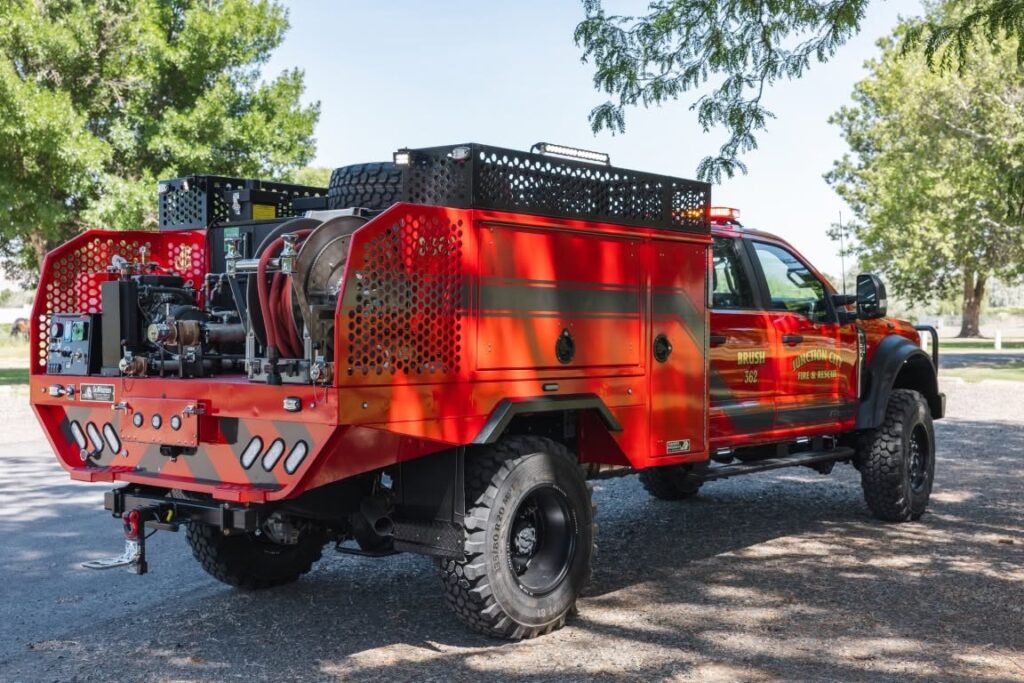
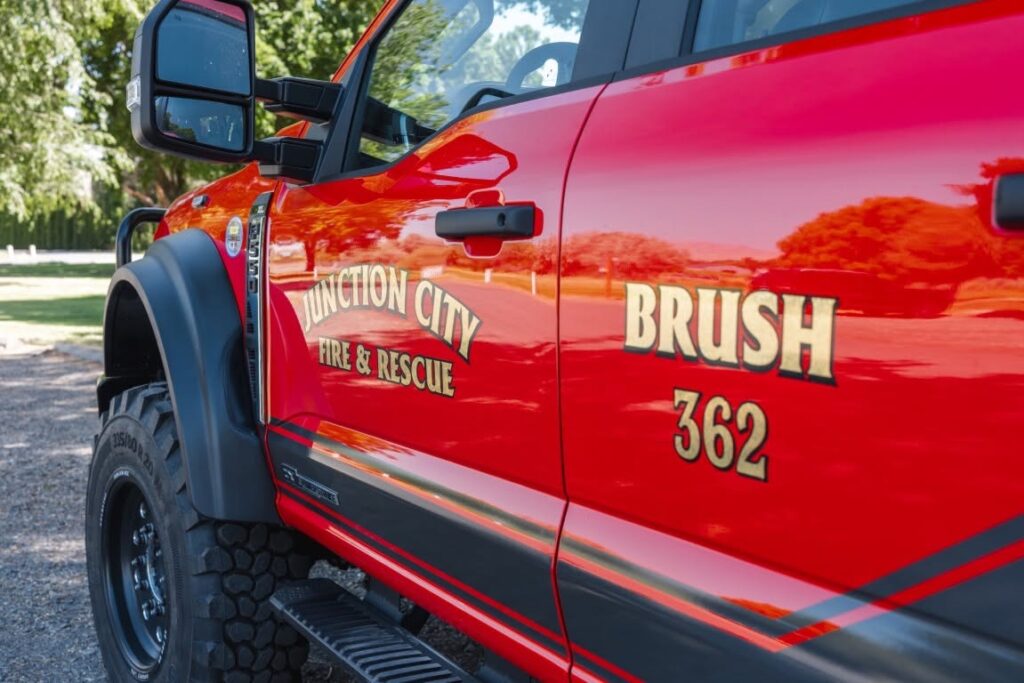
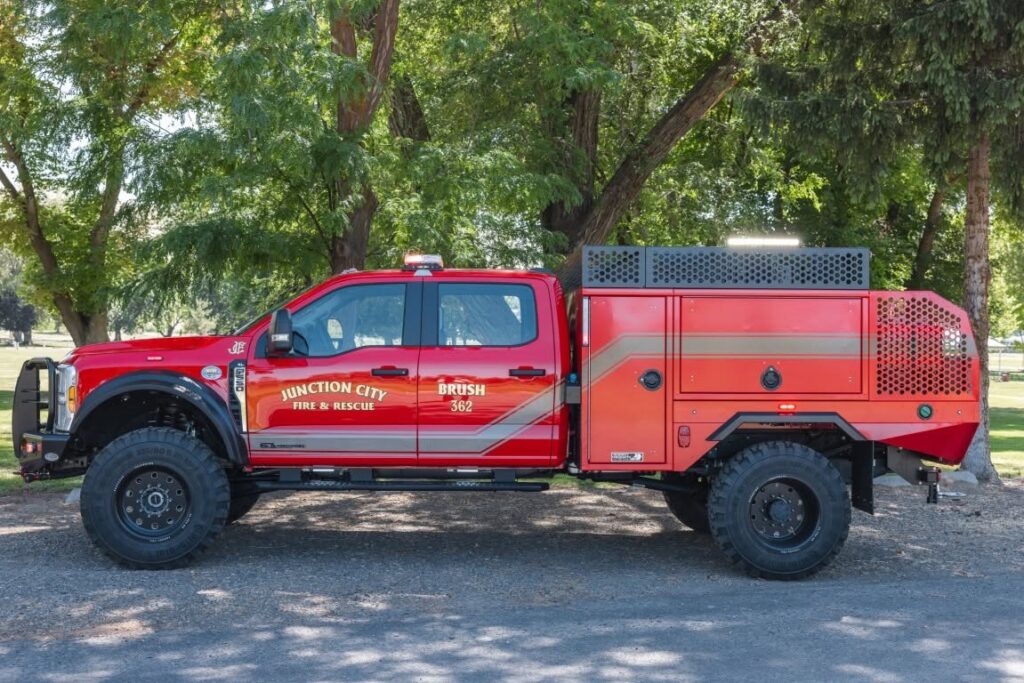
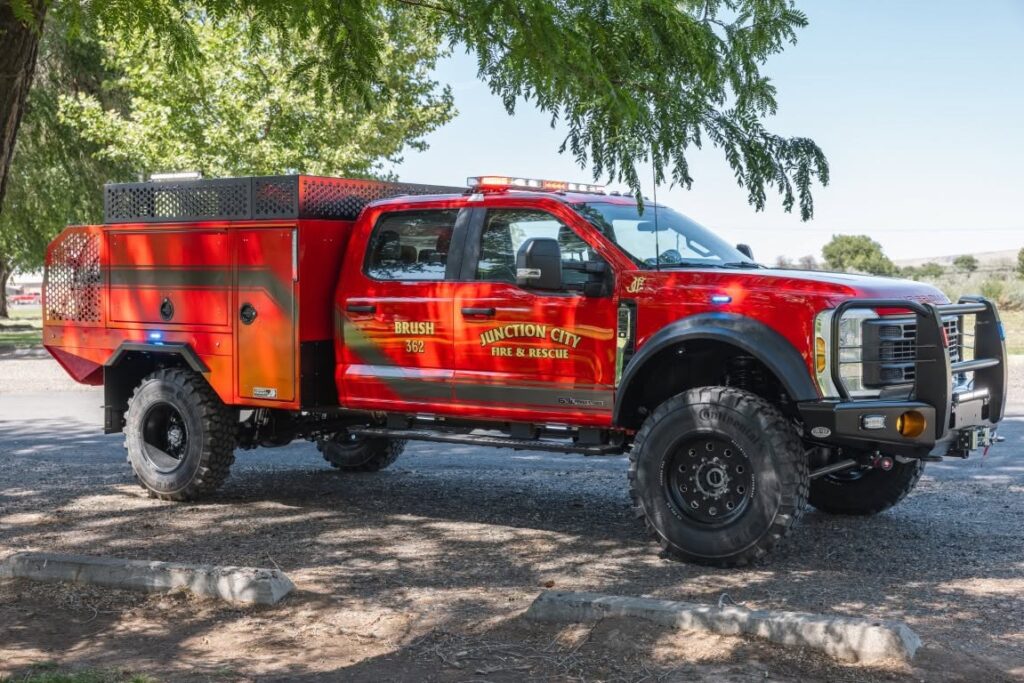
Ridgehound Emergency Vehicles recently completed a Model 1 wildland fire truck delivery for Junction City Fire & Rescue in Lane County, Oregon. The department took delivery of Brush 362, a purpose-built wildland apparatus on a Ford F-550 platform, equipped and ready to respond from day one.
This build reflects what the Ridgehound Model 1 is designed for: straightforward functionality, dependable performance, and a complete system that fire crews can trust when conditions get serious. Congratulations to Junction City Fire & Rescue on the addition of Brush 362.
Brush 362 Build Overview
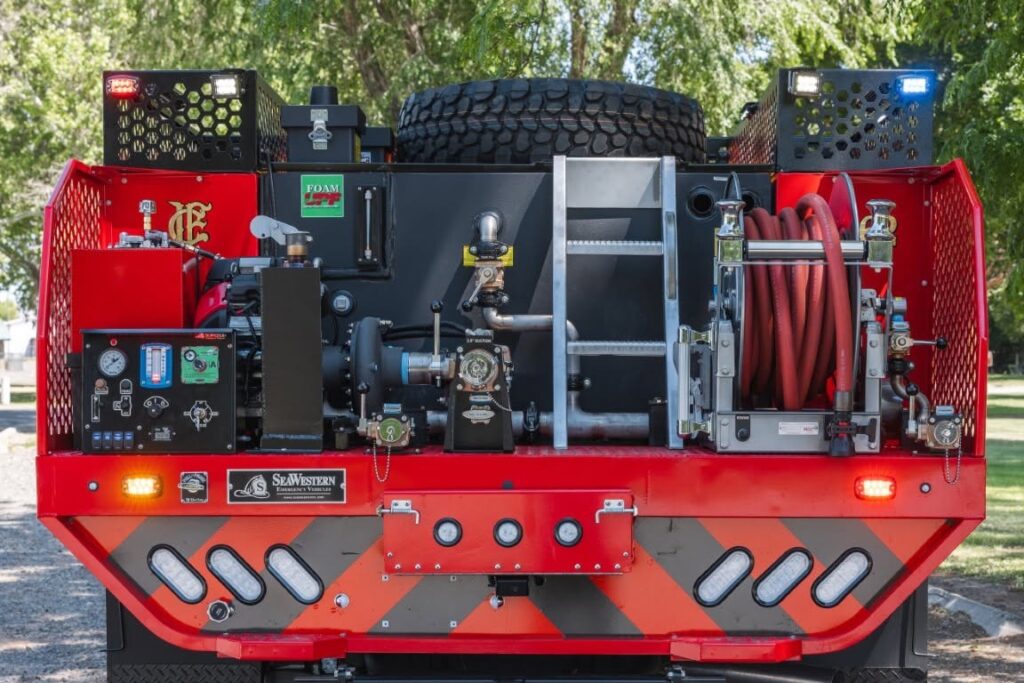
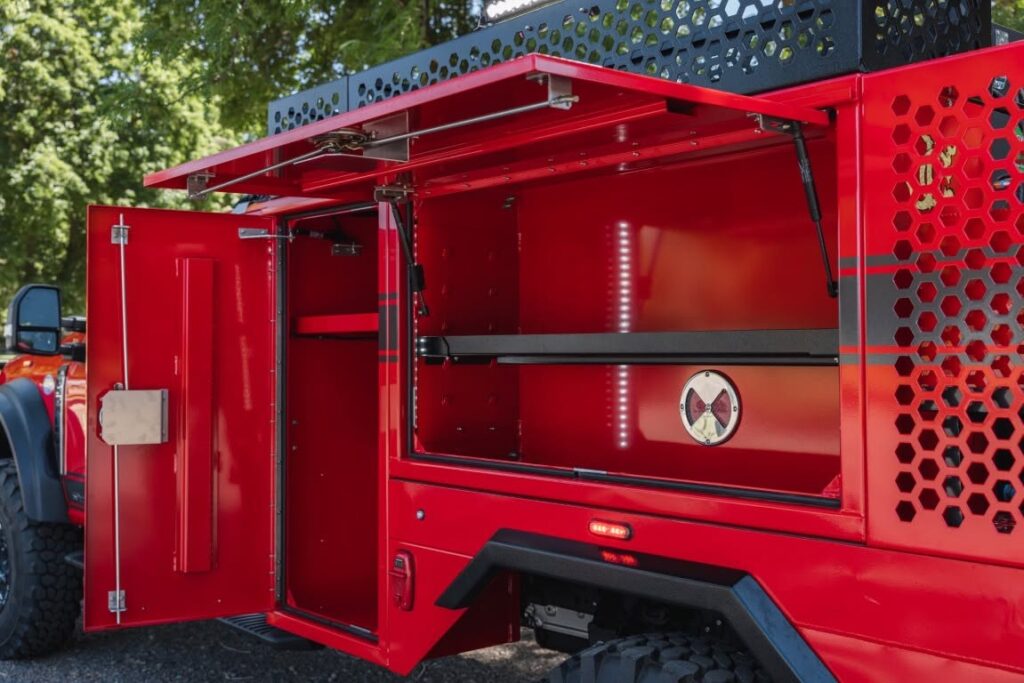
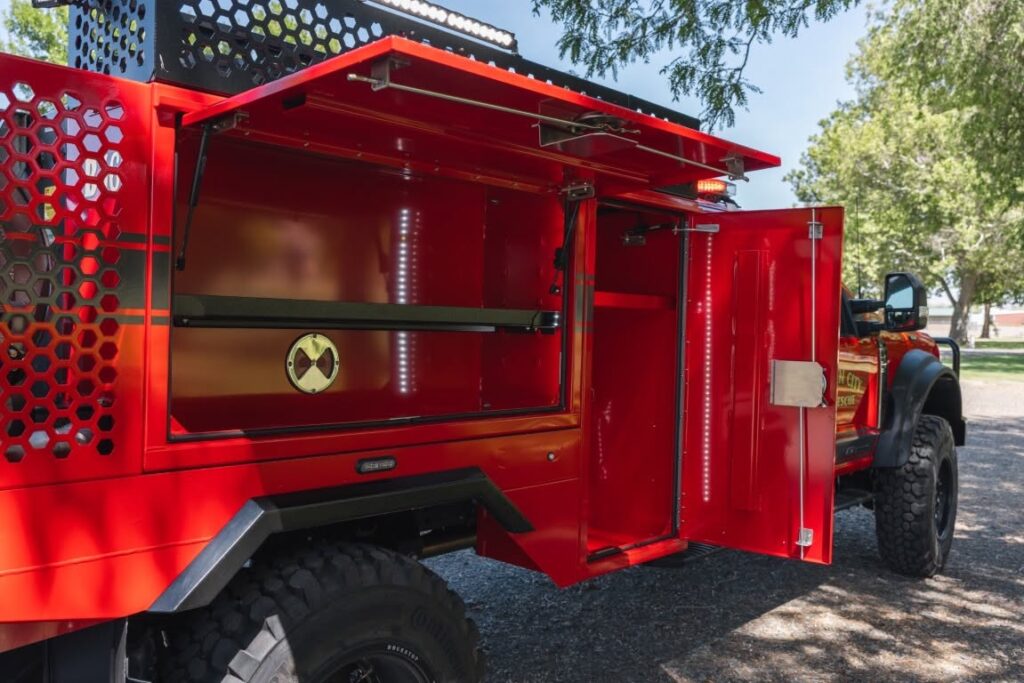
Brush 362 is built on a Ford F-550 with a 6.7L Power Stroke Diesel engine. The body is a Ridgehound Model 1 from Highway Products, constructed from all-aluminum and powder-coated to match the chassis. Every system on this truck is engineered to work together as a complete platform, not assembled from mismatched components.
Full Equipment Spec List
- 440/12 UPF PolyTank (440-gallon water capacity with integrated 12-gallon foam cell)
- Darley 2BE 21H Pump
- Trident ATP Foam System
- SWEV Actuator Dual Control System
- Topside Access Lane and Ladder
- 12-Gallon Fuel Cell
- Front Sweeps
- Rear Hose Reel (RH Deck)
- Whelen CORE Lighting and Warning Package
- Baja Designs 360-Degree Scene Lighting
- Ground and Rock Lighting
What Makes the Model 1 Wildland Fire Truck Delivery Different
The Model 1 is not a commercial chassis with fire equipment bolted on. It is a wildland apparatus designed from the ground up, built in-house by the Ridgehound EV team in Yakima, Washington. Every component is first modeled in 3D CAD before fabrication begins. Departments can review and approve every decal, discharge, and dimension before a single piece of metal is cut.
Junction City Fire & Rescue received a full set of drawings, schematics, diagrams, and product manuals with Brush 362. That documentation matters. When a system needs service two years from now, the crew has the paperwork to back it up.
Why Each Component Was Chosen
440/12 UPF PolyTank The 440-gallon tank gives crews meaningful water supply for initial attack and structure protection. The integrated 12-gallon foam cell means foam capability is built into the system from the start, not added as an afterthought. No separate plumbing runs. No extra failure points.
Darley 2BE 21H Pump The Darley 2BE is a proven workhorse in western wildland response. It delivers reliable flow rates for direct attack, structure protection lines, and engine protection. Departments across the Pacific Northwest run Darley pumps because they perform consistently in the field, not just on a test stand.
Trident ATP Foam System The Trident ATP foam proportioner is brass-constructed for durability and precision. It mixes foam concentrate accurately across a range of flow rates, giving crews effective suppression in grass, brush, and timber fuel types without wasting product.
SWEV Actuator Dual Control System This is one of the features that sets the Model 1 apart. The actuator dual control system allows operators to manage pump and tank functions from two positions on the truck. Under pressure, fewer steps and fewer hand-off points reduce the chance of operator error. The system is designed for the way crews actually work a fire, not for how it looks on a spec sheet.
Front Sweeps Front sweeps allow suppression while the apparatus is moving. In grass and light brush fires where speed of deployment matters, that capability is not a luxury. It reduces the need to stop, deploy a line, and re-stage. Crews hit the fire and keep moving.
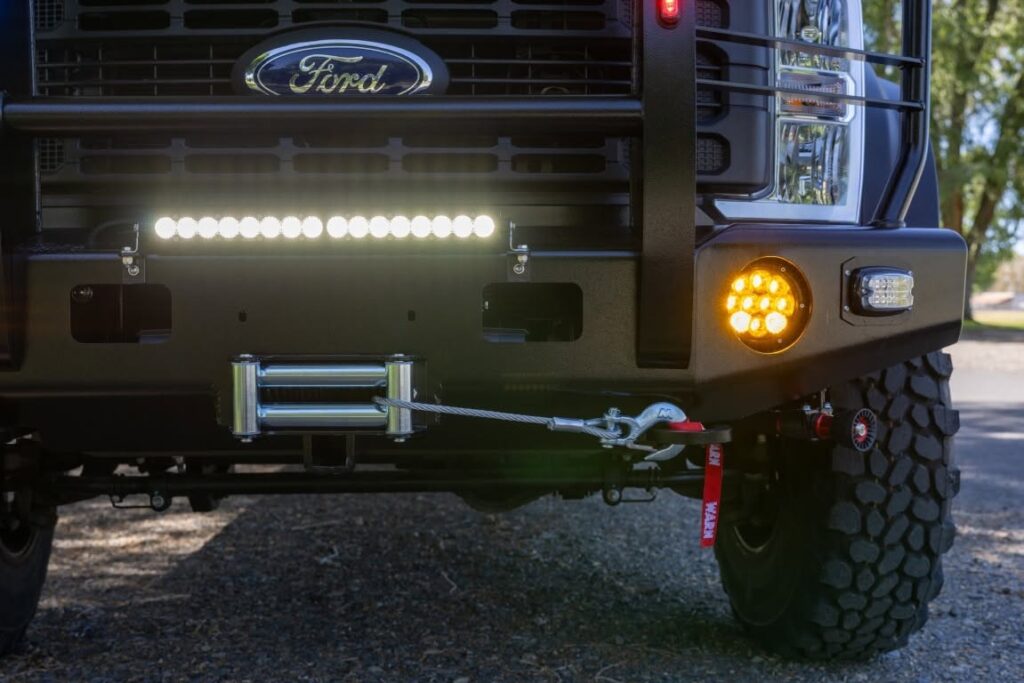
Baja Designs 360-Degree Scene Lighting and Ground and Rock Lighting Wildland response does not stop at sunset. Baja Designs scene lighting gives crews full visibility around the apparatus, while ground and rock lighting covers the uneven terrain crews are working on. A truck that is dark on the bottom is a hazard on rocky ground in the middle of the night.
Whelen CORE Lighting and Warning Package Whelen CORE is a reliable, field-tested warning system. It meets the visibility and signaling requirements that departments operating in traffic and at staging areas need, without the complexity of systems that require specialized service.
Topside Access Lane and Ladder Topside access gives crews fast, safe access to tank hatches and topside equipment storage without improvising. The ladder is integrated into the body design, not strapped on as an add-on.
12-Gallon Fuel Cell Extended deployment away from supply points is a reality in wildland response. The onboard 12-gallon fuel cell keeps the pump running when a resupply run is not an option. It is a small detail that matters on long operational periods.
Rear Hose Reel (RH Deck) The rear hose reel gives crews a fast-deploy option for structure protection and mop-up work. Mounted on the right-hand deck, it keeps the line accessible and organized without tangling.
Wildland Fire Response in Lane County, Oregon
Lane County’s wildfire risk is above average for Oregon. The county is nearly 90 percent forestland, and a large portion of its dwellings and structures sit within the wildland-urban interface, where fire can transition from timber or brush to structures with very little warning.
The 2023 Lookout Fire in the Willamette National Forest demonstrated how quickly conditions can escalate. That fire grew to over 2,700 acres under red flag conditions and prompted Level 3 “Go Now” evacuations, triggering Oregon’s Emergency Conflagration Act. Decades of fuel accumulation across the county have increased the potential for large, fast-moving fire events.
Junction City sits in the Willamette Valley floor, but the surrounding region’s timber, grass, and brush fuels create real wildland response demands for departments serving the area. A purpose-built wildland apparatus like Brush 362 gives Junction City Fire & Rescue a resource that matches those demands.
The Model 1 wildland fire truck delivery for this department is one piece of the broader effort to keep western fire departments equipped for the conditions they actually face.
About the ridgehound Build Process
Ridgehound Emergency Vehicles builds all apparatus at its facility in Yakima, Washington. The company traces its roots back to 1945 through Cascade Fire Equipment, operation as SeaWestern EV, and eventual transition into Ridgehound – with over 80 years of fire service history behind its current operation.
Every Model 1 wildland fire truck delivery follows the same process:
- Spec review and 3D CAD modeling before fabrication begins
- Department approval of drawings, dimensions, and component layout
- In-house body fabrication using all-aluminum construction
- System integration across pump, tank, electrical, and foam
- Final inspection and documentation package before delivery
The goal is a truck that does not need field modifications after delivery. Departments should be able to put it in service the day it arrives, which is exactly what Junction City Fire & Rescue did with Brush 362.
SeaWestern EV also provides EVT-certified service for the apparatus it builds. The same team that knows the system can service it.
See the Full Brush 362 Build
The complete build documentation and photo gallery for Junction City Fire & Rescue’s Brush 362 is available on the SeaWestern EV deliveries page.
- View the full build: ridgehoundfire.com/deliveries/junction-city-fire-rescue/
- Browse all recent deliveries: SeaWestern EV Truck Deliveries
- Learn more about the Model 1 platform: SWEV Model 1 Wildland Fire Truck
Frequently Asked Questions About the SWEV Model 1
What is the Ridgehound Model 1? The Model 1 is SeaWestern EV’s flagship wildland fire apparatus. It is designed and built in-house in Yakima, Washington, on either a Ford F-550 or Ram 5500 chassis. The platform is engineered specifically for western wildland response conditions, with premium components standard across every build.
What chassis options are available for the Model 1? The Model 1 is available on a Ford F-550 with a 6.7L Power Stroke Diesel or a Ram 5500 with a 6.7L Cummins Diesel. Both include a 4×4 drivetrain, heavy-duty suspension, and a 19,500 lb GVWR for maximum payload capacity.
What tank and pump configurations does the Model 1 support? The standard configuration includes a 400-gallon UPF poly tank with an integrated 12-gallon foam cell. Larger and smaller tank sizes are available depending on the compartment layout selected. Brush 362 was built with the 440/12 UPF PolyTank configuration. Pump options include the Darley 1-1/2AGE 24K and the 2BE 21H used on this build.
Does every Model 1 delivery include documentation? Yes. Every Model 1 wildland fire truck delivery includes a full set of 3D drawings, schematics, diagrams, and product manuals. Departments receive documentation for every system on the apparatus before delivery.
Can Ridgehound EV service the vehicles it builds? Yes. SeaWestern EV offers EVT-certified service and repair for all apparatus it builds. The service team is trained on every system used in SeaWestern EV builds.
How do I get a quote for a Model 1 for my department? Contact the SeaWestern EV sales team directly at (509) 453-6527 or evsales@seawestern.com. The team will walk through your department’s spec requirements and current production timelines.
About us: About
Our Facebook: https://www.facebook.com/share/p/181SGQjmwP/